
Friday’s webinar saw more than 3000 attendees hear about registration determinations, the role of State Apprenticeship Agencies and more.
On Friday, representatives from the US Department of Labor’s Office of Apprenticeship (OA) hosted a webinar to provide background and detials on recent bulletins and circulars set to overhaul the national apprenticeship system, as well as guide state apprenticeship agencies.
Talk centered around reducing administrative burden, enhancing the value proposition for employers, aligning workforce and education systems and increasing public awareness. All are laudable goals in the abstract—now the focus of apprenticeship professionals must be on the details.
Those details came into greater focus across the hour. For those that hadn’t yet dove into the recent circulars (and bulletin 202-635), OA provided the basics in slides (available here) and through an overview.
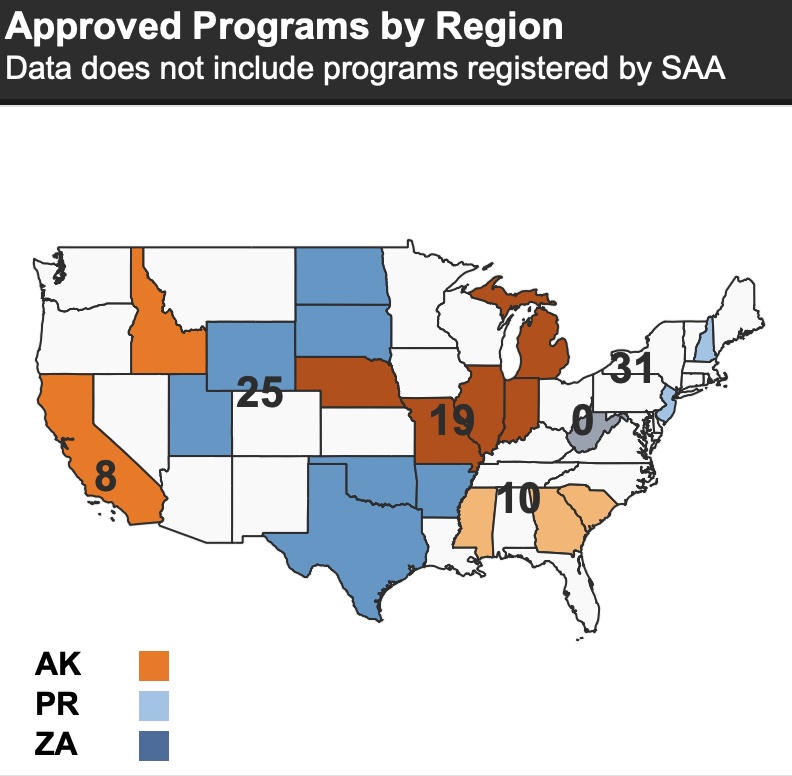
The ‘shot clock’ is likely the biggest news. OA will now make program registration determinations within 30 days. What used to take months, and often lots of back and forth, will now get done in weeks, though that does not include time it takes to develop standards. View the ‘shot clock’ here.
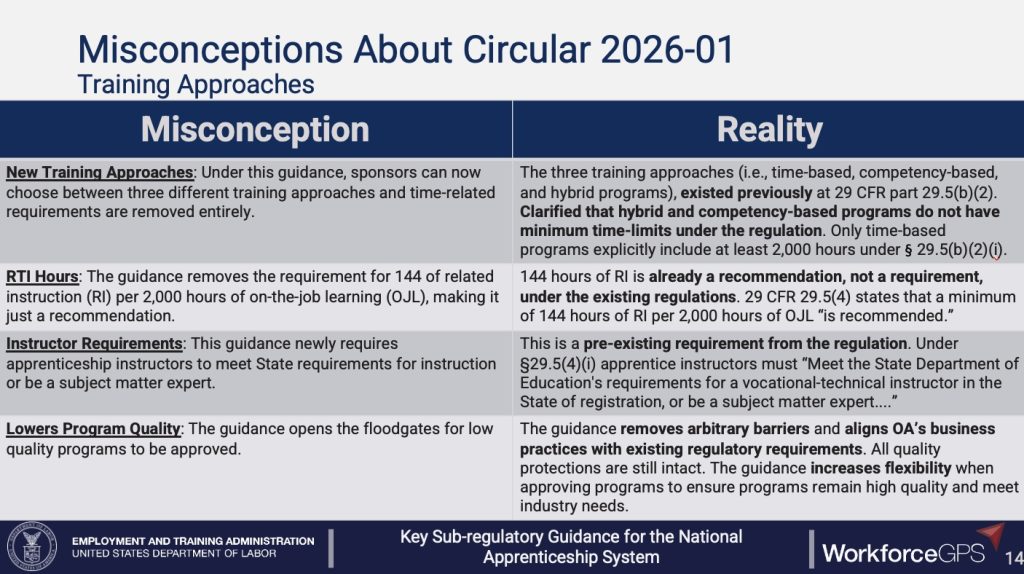
Circular 2026-01 replaces 2016-01, and clarifies the training and on-the-job hours for competency-based, time-based and hybrid programs. Our initial take on this change is that the rigor required in apprenticehsip is watered down through these regulatory changes. See the OA slide on misconception vs. reality and decide for yourself. We think less than 144 hours of instruction while still being called an apprenticeship is weak.
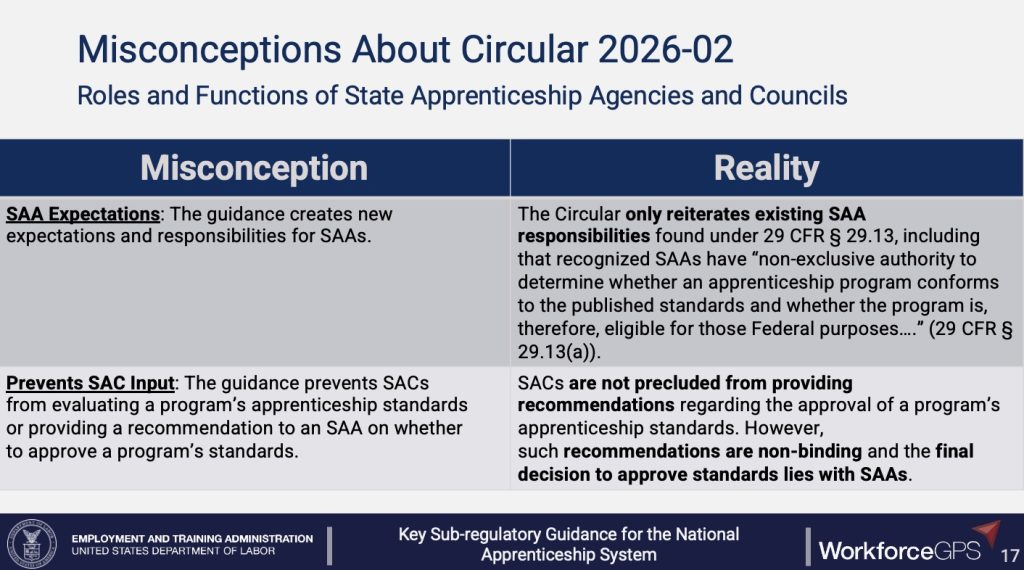
Circular 2026-02 clarifies the role of State Apprenticeship Agencies. Our background is mostly in Washington’s apprenticeship world, where the state agency and their council wield ultimate authority on all things apprenticeship.
The Agencies must now ensure their Councils do not exercise discretionary authority over apprenticeability determinations, program approvals, monitoring or deregistration. If we are reading this correctly, this will require massive changes in how Washington’s Apprenticeship Council operates, and what their purview entails. Our view is that simplifying the registration process for unions and businesses would be an overall win, but the details will matter. Check out what OA thinks the misconceptions and realities of 2026-02 are:
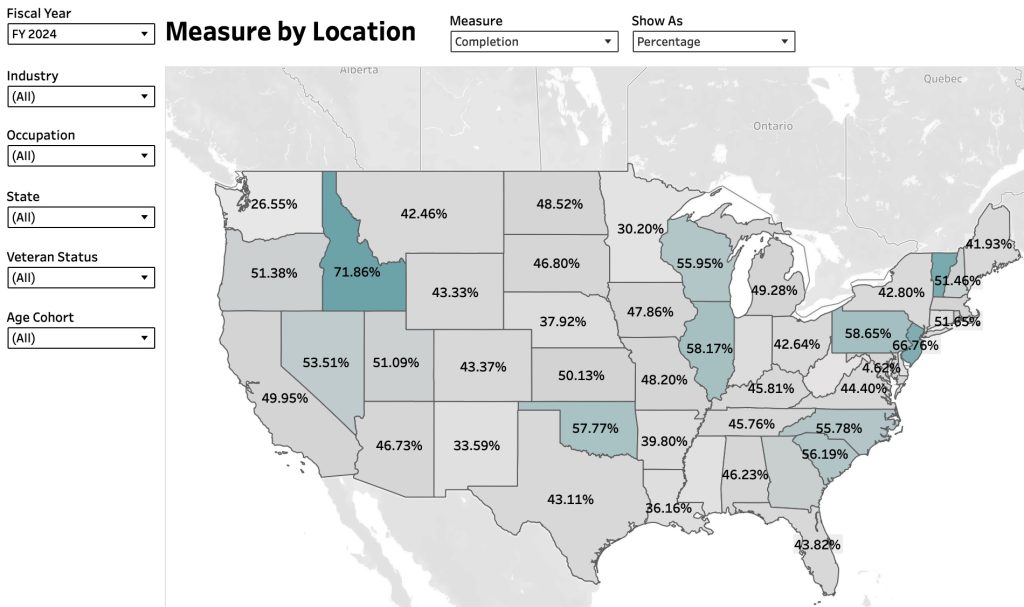
Circular 2026-03 replaces prior completion rate guidance that OA says will improve transparency of completion rates. We welcome any increased transparency around apprenticeship data, whether that’s on race, gender, occupational details or completion rates.
Of these four new pieces of guidance, 2026-03 seems like the least controversial. View the beta here. Reviewing that, Washington’s completion rate is alarming:
Do you need assistance as you prepare your state for this new guidance? We offer program management, regulatory reviews and can act as a trusted outside source of insight not bound by agency or history. Get in touch with us: jason at aspect works dot net or via LinkedIn.